There's much that is left unmapped as a city evolves, one could say as the city develops, but that's way too optimistic a stand. I was introduced to the crazy pace at which local history and practices become obsolete with the changing city in a course in my second year of Design called the Evolution of Bangalore.
Under the guidance of some really cool facilitators who know their stuff, we were able to learn the gravity of what the Peri Urban faces as Urban kingdoms raze down their fortress walls and expand into fields that sustain their growing numbers. After several weeks of study and research that touched the very surface of Economics, Urban Planning, Policy Making, talking to and visiting the peri urban population of Devanahalli, we tried to document the changes this town faced due to the building of the New Bangalore International Airport.
Now we're no Sociologists, and we tried our hand at what we know, but I think that my classmates created some remarkable projects, from mapping on textiles to exploiting the extremes of Flash and (believe it or not) Powerpoint to make animations, even 8 bit games to record some ways in which the peri urban is evolving.
For my part, I made a book called the Tall Tails of Tomorrow. But first, here's a look at Devanahalli...
 |
| An ancient residence at Devanahalli |
 |
| I'd never seen Hanuman depicted this way |
 |
Devanahalli happens to be the birthplace of Tipu Sultan
and this cool fort which soon proposes to get a flock of
tourists with the New Airport in the vicinity |
Vijipura, a peri urban town next to Devanahalli is home to several sericulture (silk producing) units.
We saw the process of acquiring silk from silk worm cocoon.
First the cocoons are auctioned in a warehouse, the two varieties present were the local silk worm cocoons that were ivory and the temperate Chinese cocoons, more sensitive to change of weather and much whiter. The price depends on the demand and the quality of cocoons which in turn affects the livelihood of the mulberry farmer and his next yield.
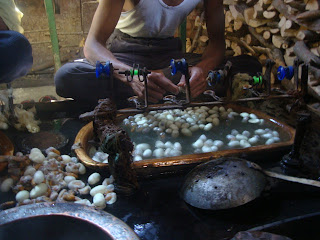 |
In suffocatingly small workshops, the cocoons are boiled
and the fine silk thread is drawn and reeled onto
huge spinning wheels.A slightly sorry sight.
|
 |
The spun silk is then polished and reeled mechanically.
The sheen is brilliant.
I wish they were never dyed. |
 |
| See what I mean? |
 |
| After it's chemically dyed, it looks like this. |
 |
The cocoon boilers and the dyers use
firewood to fuel the boiling water.
Dyeing consumes a lot of water which is
why they insist on taking huge orders. |
 |
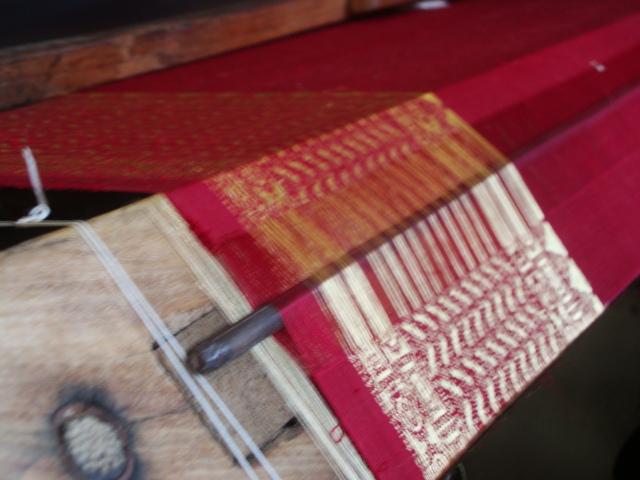
Finally, the silk reaches a loom.
Here we can see the template of the loom
of a traditional silk saree. |
 |
The pattern code is all very binary, at each point
across a given stretch of the warp
it either weaves or it doesn't. |
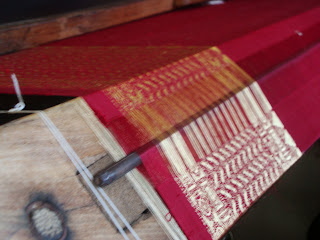 |
| That's what the result looks like, a South Silk Saree. |
 |
That's the gentleman who weaves silk sarees
at this cottage industry. Its a severely tasking
job, we saw it for ourselves.The effort that
goes into creating a silk saree is
beyond monetary measure. |
The sad story of the silk sarees of Vijipura is the quick pace at which mechanization is taking over the handlooms and its workers and how the prevalent weather changes are affecting the cocoons. A few weeks after visiting Devanahalli, I came across a news article addressing the drop in market rates for Bangalore silk on account of silk from abroad made cheaper and how people have a preference for cheaper synthetic polymers. This drove several workers of the sericulture industry to commit suicide. One could feel sorry for the silk moth, which is a beautiful creature - I saw them hatch at a friend's place, or for the industry. But the sad truth for sericulture workers, like the cotton farmers at Wardha, is their helpless situation that is ruled by market trends and the changes that the Urban imposes on them.
This is just one of the many changes we observed at Devanahalli that we felt needed recording.